


Why Web3 Feels Different Than Web2: What You Need to Know Before Getting Started
If you've spent years using the internet, you know exactly what to expect: log in with an email, reset your password when needed, and watch actions complete instantly. But when you first encounter Web3, something feels… different. And that's not by accident.
Web3 Is Powerful, But It Works Differently Than Web2
Web3 doesn't behave the same way as the internet you're used to. This isn't because it's broken or unfinished. It's because Web3 is built on fundamentally different principles than Web2. This guide will help you understand why Web3 feels different before you try to use it. The goal is simple: recognize what's normal in Web3 so you don't mistake "different" for "broken."
Key Takeaway: Web3's unusual behavior isn't a bug- it's a feature. Understanding this fundamental difference will save you hours of frustration.
Web2 and Web3 Are Designed With Different Priorities
The differences between Web2 and Web3 aren't superficial. They stem from completely different architectural philosophies.
How Web2 Works: Convenience First
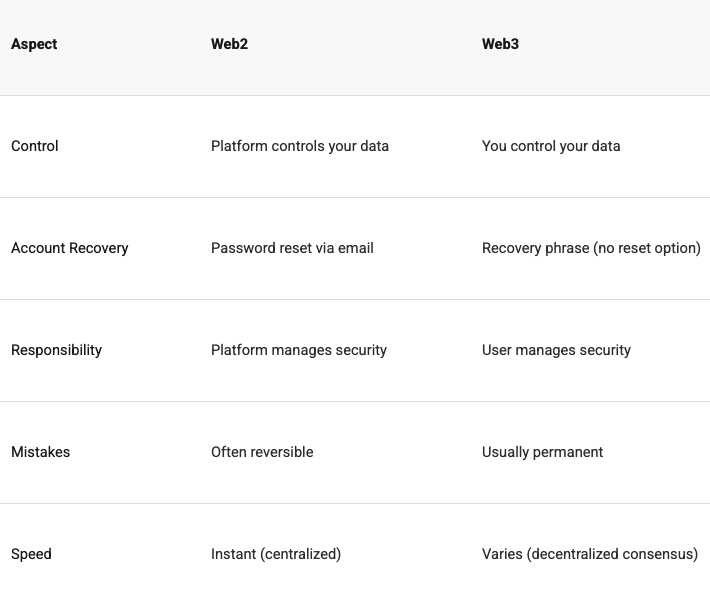
Web2 platforms are optimized for convenience and recovery. When something goes wrong, there's usually a way to undo it or contact support to fix it. Forgot your password? Click "reset password." Made a mistake? Customer service can help. Most responsibility sits with the platform, not the user. Companies like Facebook, Google, and Amazon maintain centralized databases where they control your data, manage your account, and can intervene when problems arise.
How Web3 Works: Ownership First
Web3 systems are designed around ownership and decentralization. Instead of relying on a central service, users directly control their identity, assets, and permissions. Because there's no single authority managing the system, responsibility shifts to the user. That tradeoff is intentional and fundamental to how Web3 works.
Why Web3 Requires More Attention
People are often surprised when Web3 applications ask them to review and approve actions more carefully. Why all the confirmation prompts? Why so many warnings? In Web3, actions are not just interface interactions. They represent real changes that affect ownership, value, or permissions. For example, approving an action in a digital wallet isn't the same as clicking a button in a traditional app. You're explicitly authorizing a change that the blockchain will respect and execute, without a central party reviewing or reversing it later.
What This Means in Practice
- No "undo" button: Once a transaction is confirmed on the blockchain, it's permanent
- No customer support to reverse mistakes: There's no centralized company that can help if you send funds to the wrong address
- You're signing with real value: Approving a smart contract can grant permission to access your digital assets
This is why Web3 encourages deliberate decisions rather than fast, automatic ones. The extra friction you feel isn't poor UX design. It's a necessary safety feature.
Why Actions Are Not Always Instant
If you're used to Web2, waiting for an action to complete can feel like something went wrong. In Web3, waiting is often just part of the normal process.
Why Web2 Is Fast
Web2 systems are fast because they're centralized. One company controls the infrastructure, and one database confirms what happened. When you post on social media or make a purchase, that single system processes and confirms it instantly.
Why Web3 Takes Time
Web3 systems are decentralized. When you submit a transaction:
- Your transaction is broadcast to a network of independent nodes
- Multiple validators must independently verify the transaction
- The transaction must be included in a block
- The network must reach consensus that the block is valid
- Several confirmations ensure the transaction is final
This process takes time. Sometimes just a few seconds, sometimes several minutes, depending on network congestion and the blockchain being used.
Important: Waiting does not automatically mean something failed. In many cases, it simply means the decentralized network is completing its normal consensus process.
Why Web3 Experiences Can Feel Unfamiliar
Web3 is still early compared to Web2. And that shows in the user experience.
The Maturity Gap
Web2 has benefited from decades of iteration, standardization, and abstraction. Much of the technical complexity is hidden from users. You don't think about HTTP requests, server architecture, or database queries when you browse Instagram.
Web3 is still evolving. Different parts of the ecosystem mature at different speeds, which means:
- Experiences vary significantly between applications
- A digital identity or name may appear in one app but not yet in another
- Some actions require more manual steps and confirmations
- Feedback isn't always immediate or clear
Example: The Simple Action That Isn't
Setting up a digital wallet or approving a transaction may look straightforward in one app, while another app surfaces more prompts, confirmations, or warnings for the same underlying action. This doesn't mean progress has stopped. It means the ecosystem is still forming, and standardization is ongoing.
Understanding This Difference Changes How You Approach Web3
A large part of Web3 frustration comes from mismatched expectations. When people expect Web2 behavior from a Web3 system, normal outcomes can feel like failures:
- Seeing a digital wallet address instead of a username looks like missing data, but it's how digital identity works
- Waiting 30 seconds for a confirmation without a progress bar feels broken, but the blockchain is processing normally
- Being asked to carefully review an irreversible action seems paranoid, but it's appropriate given the stakes
The system isn't malfunctioning. It's simply operating under a different model.
Once this difference is understood, navigating Web3 becomes less confusing and more predictable. You'll know:
- When to be patient (network is processing)
- When to be careful (action is irreversible)
- When something is actually wrong (vs. just different)
Key Takeaways
- Web3 prioritizes ownership over convenience. This fundamental design choice explains most of the differences you'll encounter.
- Actions in Web3 are irreversible. There's no "undo" or customer support to reverse mistakes, which is why extra confirmation steps exist.
- Decentralization requires time. Multiple independent nodes must reach consensus, which takes longer than centralized systems.
- The ecosystem is still maturing. Inconsistencies between applications are normal as standards continue to develop
- Different doesn't mean broken. Understanding Web3's operating model prevents frustration and helps you make better decisions
More Resources on What to Expect With Web3
Web3 introduces a level of ownership that Web2 never offered. That shift brings both power and responsibility. It's important to understand what kind of system you're interacting with in Web3.
Ready to Continue?
With the right expectations, learning what comes next becomes significantly easier. In our next guides, we'll break these concepts into practical situations you'll actually encounter, from setting up your first digital wallet to completing your first transaction.
More Guides on What to Expect With Web3
Web2 Is Convenience and Recovery. Web3 Is Ownership and Responsibility
What to Expect in Web3: Connecting a Digital Wallet Instead of Logging In
Web3: Signing Actions Instead of Clicking Buttons
What to Expect in Web3: Transaction Fees
Web3: How Digital Wallet Connection Works
What to Expect in Web3: Irreversible Actions
What to Expect in Web3: Different Digital Wallets, Different UI Support
What to Expect in Web3: Digital Identity Varies Across Applications and Wallets


